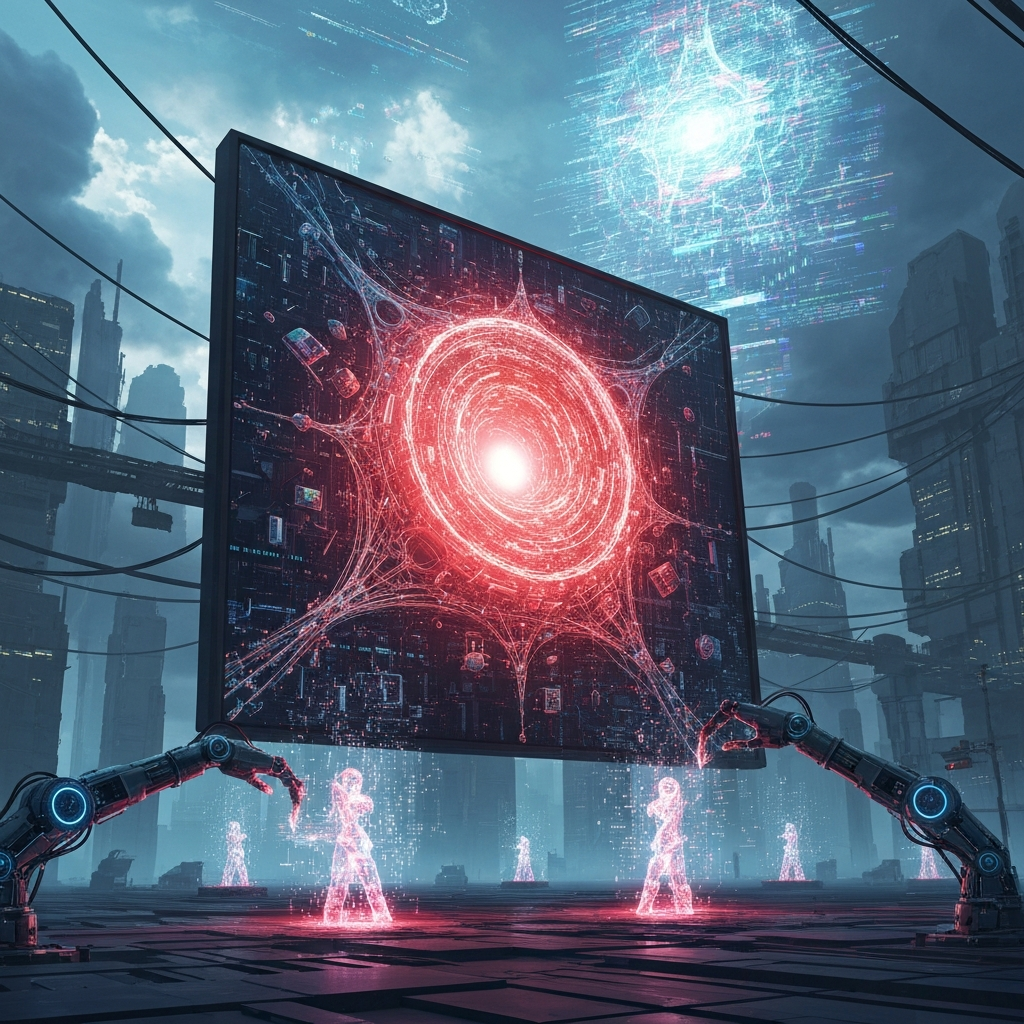
Artificial intelligence has completely changed many industries. Art isn’t special. We’re seeing a cool new time, shaped by **AI creativity**, where computer programs aren’t just handling information; they’re actually making fresh, interesting art. This big change makes us wonder how machines are starting to challenge what we’ve always thought about art, imagination, and who makes it. Is art only for people? Can AI systems really have new ideas? Artists, tech experts, and fans are all asking these questions as the lines between human and machine smarts get fuzzy, bringing an exciting, but tricky, future for art.
The Start of AI Art: Computers as Creators
For ages, we’ve connected the idea of an artist with human feelings, life experiences, and personal views. But a big change is happening now. Programs are getting noticed as real helpers in the art world. This trend, often called AI art, covers many digital things. It includes strong pictures and complex music. Plus, these AI systems, using smart machine learning, can learn from huge collections of old art. They develop a special ‘feel’ for style, shape, and what looks good. That’s why they make new pieces that often feel surprisingly fresh. It makes us wonder about what artistic talent really is. Also, we’re rethinking what a human artist does. Are they mostly just picking things out or working with the AI?
How AI Makes Creative Stuff
The way AI makes creative stuff is carefully set up. It uses smart computer tricks. Mainly, we use generative adversarial networks (GANs). These are two computer brains, a maker and a judge, that fight each other. The maker tries to build new examples that look like the training info. Meanwhile, the judge checks if the made stuff is real or fake. This back-and-forth helps the maker get better and better at producing very real and fresh results. Sometimes, we also use variational autoencoders (VAEs). These learn to squeeze information into a smaller hidden space and then spread it back out. This lets them make completely new things, but still in the same style. So, these methods let us check out art styles and ideas we couldn’t even dream of before. Innovation just keeps coming from these computer programs.
Looking at Generative AI Art and What It Does
Generative AI art has hit the creative industries hard. Designers are getting new tools for quick trials. Musicians are checking out fresh sounds. Visual artists are pushing what art can be. This new tech has made creating art easier for everyone. People without old-school art training can now try out fancy art styles. So, we’re building a more open creative world. Art isn’t just for a few special people anymore. The huge amount and many types of art these systems make also hint at a future where custom art could be everywhere. It’ll make art experiences fit exactly what each person likes, in a way we’ve never seen.
When Do Computers Turn into Artists?
A really important question people keep asking is, ‘When do computers turn into artists?’ This question starts to look at the deep ideas behind what AI can do more and more. Sure, AI systems can definitely make beautiful and fresh pieces. But calling something an ‘artist’ usually means it has a plan, knows what it’s doing, and wants to show itself. Those are things we’ve always tied to human makers. But as AI programs get harder to understand and their results become less predictable, the lines aren’t so clear anymore. If a computer program makes a piece on its own that brings up strong feelings or questions old rules, does not having a human-like mind mean it’s not good art? This talk keeps changing. It shows how society is still trying to figure out what creativity means in our tech-heavy world.
Where AI Meets Human Ideas
Even though AI can do amazing things, many people argue that its real strength in art comes from working with human ideas. We don’t see AI taking over human creativity. Instead, it’s making it bigger. It gives artists new tools and ways to look at things. When human gut feelings mix with computer exactness, totally new kinds of art show up. Artists are using AI to check out huge creative areas, try out tricky designs, and get past creative roadblocks. This helps them stretch their own imagination further. So, this team-up promises a future where art is richer, more varied, and more connected with new tech.
What AI Does to Human Art Skills
What AI does to human art skills is pretty complex. Some people worry that relying too much on AI could make old art skills and basic training less important. They fear that making hard pictures with just a few commands might make years of hard work in painting, sculpting, or drawing seem worthless. But another idea says AI helps artists focus on the big picture and their ideas. It lets them pass off boring or repeated jobs to computers. This lets human artists step up their game. They can highlight their special ability to fill art with stories, feelings, and deep thoughts. These things are still mostly too hard for today’s AI. So, human art skills aren’t going away. They’re just changing to more advanced creative guiding and careful picking.
Fair Questions About AI Art
As AI creativity grows, we’ve got to deal with many fair questions. Copyright and who owns what are super important. Figuring out who owns AI-made pieces, especially when they learned from tons of human art, causes big legal problems. Plus, people worry AI might keep old prejudices found in its training info. This could lead to art that doesn’t show everyone or even hurts people. Being clear about how art is made is also key. It lets people know if a piece was mostly made by AI or a person. So, we must build and use these fair rules. This will make sure AI in art moves forward in a way that’s good and fair for everyone involved.
- Copyright and ownership of AI-generated works.
- Potential for biases in AI-generated content.
- Transparency regarding AI authorship in art.
Can AI Really Be Creative Like Us?
The main question of if AI can really be creative like people is still a hot topic. We often say human creativity means having a mind, feelings, a plan, and fresh ideas that go beyond what’s been learned. Sure, AI can make very original things. It can even surprise its makers. But these actions come from computer programs and data, not from inner feelings. But AI’s abilities are stretching what creativity means. If we judge creativity only by how new and impactful the result is, then AI probably fits. However, if it needs a thinking mind and a planned act of showing oneself, then today’s AI models don’t quite make it. This deep talk will definitely keep changing as AI tech gets better. It’s pushing us to look again at what it truly means to be creative.
Conclusion
Looking at AI creativity shows us a fast-changing world. Tech and art meet in ways we’ve never seen. It’s clear that AI has become a strong power. It lets us make new kinds of art. It also makes us question old ideas about who makes art. While AI gives huge chances for new ideas and makes art easier to get to, it also means we need to think hard about fair problems. We also need to keep rethinking what human artists do. In the end, human ideas and artificial intelligence will likely shape art’s future together. This will build a richer, more varied, and more thought-provoking art world. This journey into new territory has just started. It promises endless fresh ideas and deep looks into what creativity really is.