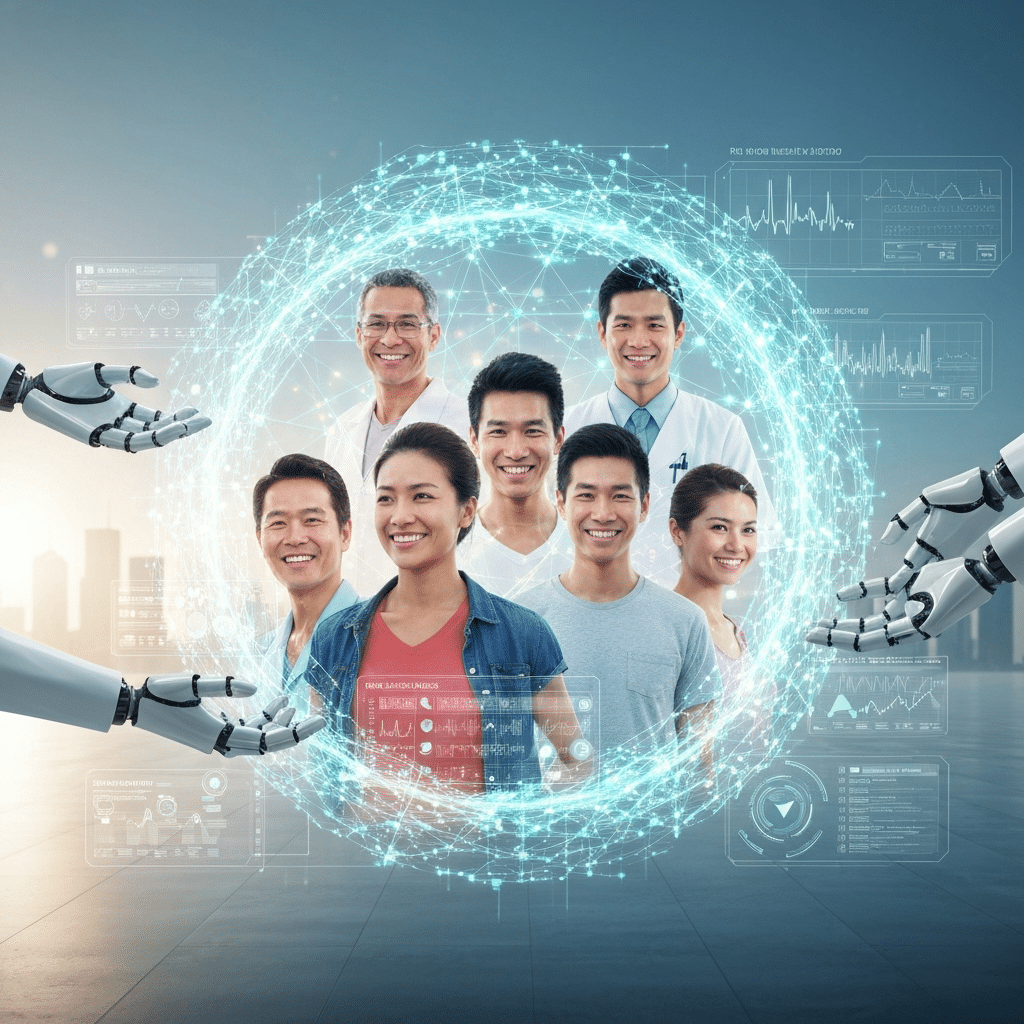
Nowadays, **Healthcare AI** is really shaking up modern medicine. This powerful tech, once just a dream in sci-fi books, is now a real game-changer. It promises big improvements for patient care, research, and how hospitals run. Truly, artificial intelligence in medicine isn’t just a small step forward; it’s a huge shift. Many places around the world are using it, completely changing how we tackle health problems.
The Start of AI in Medicine
Bringing AI into healthcare marks a big moment. We’re already seeing many benefits of AI in healthcare. From making admin tasks easier to giving more exact diagnoses, AI medical solutions offer so much. A key part of this change is the rise of machine learning healthcare. Here, smart computer programs learn from tons of data. They find patterns and make predictions with amazing accuracy. So, the healthcare industry is experiencing a time of fresh ideas, all thanks to these intelligent systems.
AI in health tech does many things and makes a real difference:
* **Better Diagnoses:** AI systems help analyze medical images. They give us more accurate and earlier ways to find diseases.
* **Custom Treatments:** We can now develop treatments just for you. AI looks at your genes and lifestyle data to make them personal.
* **Smooth Operations:** AI-powered automation takes away a lot of office work. This lets healthcare pros spend more time with patients.
How AI Helps Diagnose and Treat Diseases
One of AI’s biggest impacts on healthcare is in disease diagnosis. Think about AI medical imaging, for example. It’s completely changed how radiologists look at scans. Machine learning programs find tiny things in X-rays, MRIs, and CT scans that a human eye might miss. This helps us get earlier and more accurate diagnoses. Plus, predictive analytics healthcare systems now predict disease outbreaks. They also find patients at high risk for certain conditions. This means doctors can step in early and create custom treatment plans. For people with long-term illnesses, AI-powered solutions for chronic disease management help patients and doctors. These tools watch vital signs, make sure people take their medicine, and track lifestyle choices. This leads to better long-term health. Because of these smart tools, we’re building a health approach that’s more about preventing problems and reacting quickly.
Boosting Medical Research and Finding New Drugs
AI doesn’t just help with diagnosis and treatment; it’s also a big helper in medical research. Finding new drugs used to take ages and a lot of hard work. Now, AI drug discovery platforms speed things up. These platforms check molecular structures, guess how well a drug will work, and find possible drug candidates much faster than old ways. Also, AI tools for medical research help us sort through huge amounts of scientific papers. They pull out key facts and find new connections. This really makes coming up with new ideas faster. Deep learning in medicine, a type of machine learning, is extra helpful here. It looks at complex biological data, from genes to proteins. It shows us things we couldn’t see before. So, the speed of scientific discovery is really picking up.
How AI Changes Patient Care and Personalized Medicine
AI changes patient care in many ways, and it feels very personal. Patients get treatment plans made just for them. This is thanks to machine learning algorithms for personalized medicine. These programs look at a person’s genes, lifestyle, and health history to suggest the best treatments. AI also makes healthcare easier to get, especially in far-off places. It does this through telemedicine platforms that use AI diagnostics. The whole patient experience gets better with simpler steps, shorter waits, and a bigger focus on what each person needs. This helps us create a healthcare model where what you want and what your body needs are super important.
Thinking About Ethics and What’s Next for Healthcare AI
Like any strong technology, we must think carefully about the ethical considerations of AI in healthcare. People are actively talking about questions around data privacy, fairness in AI programs, and who is responsible for AI-made decisions. We need good rules and clear ethical guides. These will make sure we build and use AI responsibly and fairly. Looking ahead, the future of AI in the healthcare industry looks really bright. New advances, like quantum computing and explainable AI, should open up even more possibilities. They will bring us more advanced AI medical solutions. These will change what’s possible in health tech. Working together – doctors, researchers, and AI developers – will be key as we explore this new and exciting area. This will make sure technology helps all of us.
So, Healthcare AI isn’t just a tool; it’s a vital partner in how medicine grows. It does so much: it makes diagnoses more exact, speeds up finding new drugs, changes patient care, and helps create personal medicine. Its reach is wide and keeps growing. Yes, we know there are challenges, especially ethical ones, and we’re working on them. But the path for AI in health tech points to a future where medical care is smarter, easier to get, and most importantly, more focused on people. AI’s amazing impact on medicine is clear, promising a healthier tomorrow for everyone.