In 2026, a fundamental shift is being witnessed within the landscape of corporate automation. Specifically, the previous reliance on monolithic Large Language Models is being abandoned in favor of AI Swarm Systems. Higher accuracy and lower operational costs are frequently reported when business processes are deconstructed into specialized digital workforces.
The Limitation of Monolithic Models
Initially, a single “God Model” was viewed as the ultimate solution for every enterprise task. It was assumed that intelligence could be scaled simply by increasing parameters. However, “Context Fatigue” is often experienced when a single model is forced to manage excessive complexity.
Consequently, hallucinations are generated when a model is overwhelmed by long-winded prompts. Constraints are often forgotten by the AI when execution reaches the final stages of a workflow. Therefore, a transition from a single “brain” to a collaborative ecosystem is being prioritized by leading organizations.
The Anatomy of the Specialized Swarm
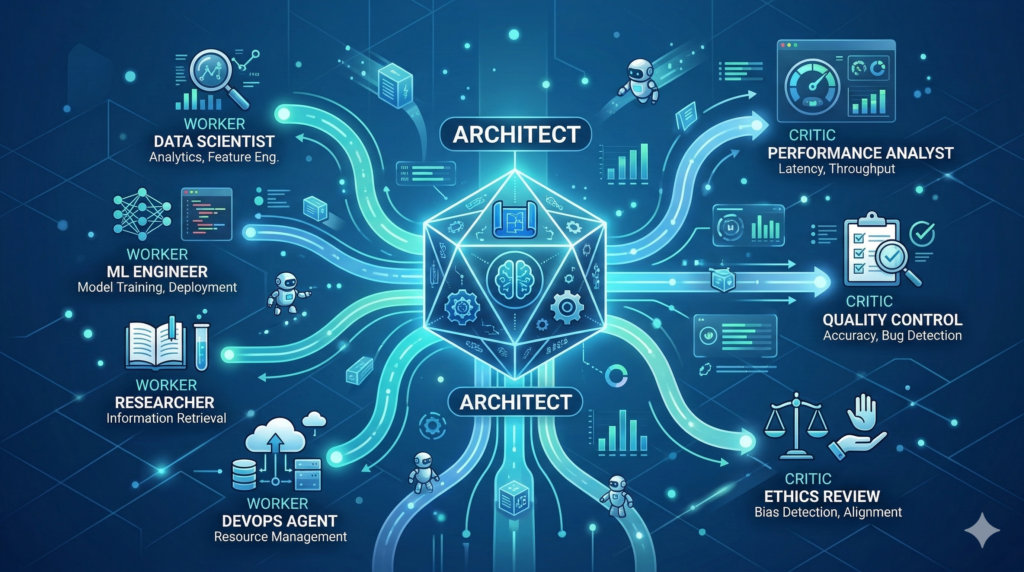
In a Multi-Agent System (MAS), the workflow is no longer handled as a linear script. Instead, specialized roles are assigned to various digital entities to create a modular workforce.
- The Planning Architect: The project plan is deconstructed by the Architect agent. High-level goals are transformed into sequential tasks. No direct work is performed by this agent; instead, the orchestration of sub-agents is managed.
- The Specialized Workers: Specific actions are executed by Small Action Models (SAMs). Databases are navigated by the Data Miner, while verified sources are analyzed by the Researcher. Coding tasks are handled exclusively by fine-tuned Python agents.
- The Adversarial Critic: The output of the Workers is scrutinized by the Critic agent. Flaws, security vulnerabilities, and brand violations are identified before any final result is delivered. Accuracy is significantly increased when an adversarial loop is maintained between agents.
Advantages of the Modular Approach
Three primary headaches are solved by the implementation of MAS: fragility, cost, and latency. First, resilience is offered by modularity. If a single agent fails, the entire process is not crashed. Instead, the specific component is rebooted by the Architect or a different tool is utilized.
Furthermore, cost optimization is achieved through strategic routing. Expensive, high-reasoning models are only utilized for complex critiques or architectural planning. Meanwhile, simpler tasks are delegated to smaller, cost-effective models to save resources.
Finally, semantic stability is maintained. A narrow focus is kept by each agent, ensuring that contractual rules or technical specifications are not lost during the process. Specifically, a Legal Agent is less likely to drift than a General AI.
The Technical Foundation: MCP
In 2026, the Model Context Protocol (MCP) is recognized as the trending technical standard for these systems. Communication between different AI providers is enabled by this “glue.” Consequently, an agent from one ecosystem can seamlessly share its state with an agent from another.
A transparent audit trail is also generated by this architecture. The “reasoning trace” is logged, allowing for every decision to be reviewed by human supervisors. The final answer is no longer accepted blindly. Instead, the “Slack-like” debate between agents is fully visualized for total transparency.
Case Study: Insurance Claims Automation
Claims processing has been revolutionized by the deployment of specialized swarms. In this framework, car damage is assessed by a visual intake agent. Simultaneously, fraud markers are analyzed by a specialized cross-referencing agent.
Policy coverage is verified by a dedicated document agent, while pricing is checked via real-time APIs. Subsequently, a final report is presented to a human-in-the-loop. Processing times have been reduced from weeks to mere minutes through this collaborative method.
Challenges and the Future
Management of the “Silicon Workforce” is now required from enterprise leaders. New roles, such as the Agentic Orchestrator, are being created to oversee these systems. However, risks like “Infinite Loops” must still be mitigated.
Circuit breakers are implemented to prevent agents from disagreeing indefinitely. When token budgets are exceeded, the system is frozen and a human intervention is triggered. Ultimately, intelligence is viewed not as a solitary trait, but as a social collaboration.

Related posts:
 Mastering the Systems That Run Our World: A Guide to Excel Automation and Tech Tools
Unlocking the Secrets of Global Systems: A Deep Dive into Excel Automation and Innovative Technology Tools
Discovering the Backbone of Modern Careers: A Journey Through Systems and Automation
Navigating the Digital Landscape: A Guide to Mastering Systems and Excel Automation
Mastering the Systems That Run Our World: A Guide to Excel Automation and Tech Tools
Unlocking the Secrets of Global Systems: A Deep Dive into Excel Automation and Innovative Technology Tools
Discovering the Backbone of Modern Careers: A Journey Through Systems and Automation
Navigating the Digital Landscape: A Guide to Mastering Systems and Excel Automation